What Happens If You Fail a Module Abroad? Resits, Repeat Years and Student Visa Rules
16 Nov, 2026
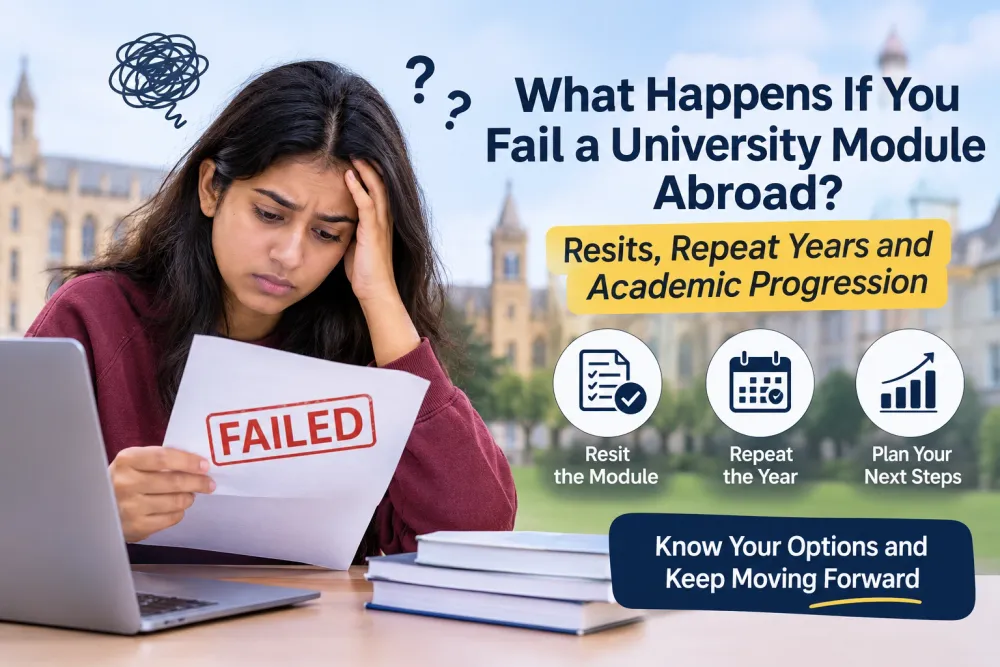
Failing a university module abroad does not automatically mean you will lose your student visa or have to repeat your entire academic year. The outcome depends on your university's academic regulations, the number of modules you have failed, your course progress and the immigration requirements of your destination country.
For international students, however, a failed subject can create several practical concerns. You may need to take a resit examination, repeat an assignment, retake a module in another semester or extend your course. In some situations, this can affect your expected graduation date, tuition fees and student visa arrangements.
The rules are not the same everywhere. For example, UK universities have specific procedures for resits, repeat study and Confirmation of Acceptance for Studies (CAS), while Australian education providers monitor international students' course progress under the ESOS framework.
This guide explains what happens when you fail a module as an international student, the difference between a resit and a repeat year, how academic progression is assessed, and what you should do to protect your studies and visa status.
What does failing a university module mean?
A module is a subject or unit of study that forms part of your university course. For example, an international student studying a Master's in Information Technology may take modules such as programming, database management, cybersecurity and software engineering.
If you fail one module, it means you have not achieved the minimum academic requirements for that particular subject. This does not necessarily mean you have failed your entire degree.
Your university will assess the result according to its academic regulations. Depending on the course and the reason for the failure, you may be offered another assessment attempt, asked to repeat the module or required to complete additional academic work.
The terminology can also differ between countries:
- UK: Universities commonly use the terms module, resit and repeat study.
- Australia: Universities commonly use unit, supplementary assessment, reassessment and course progress.
It is important to understand the difference because a failed module can have academic, financial and immigration implications depending on your circumstances.
What happens if you fail a module as an international student?
When you fail a module, your university usually reviews your academic record and determines what you need to do next. The outcome depends on the assessment you failed, your overall course performance and the university's progression rules.
You may face one or more of the following outcomes:
- Resit an examination: You may receive another opportunity to pass the examination.
- Resubmit an assignment: Some universities allow students to correct and resubmit coursework, subject to their assessment rules.
- Repeat the module: You may need to study the subject again in a future semester.
- Repeat part of the academic year: If several modules are incomplete, you may need to repeat a semester or part of your programme.
- Extend your course: If the failed module is a prerequisite for later subjects or is only offered once a year, graduation may be delayed.
- Receive academic support: Your university may recommend additional classes, tutoring or an academic improvement plan.
Not every university offers all these options. Some modules, particularly those involving clinical placements, laboratory work, professional accreditation or practical assessments, may have additional requirements.
Example: Imagine you are studying a two-year Master's degree and fail one compulsory module in your first semester. Your university may allow you to resit the examination during the next assessment period. If you pass, you may continue with your course without repeating the full semester. However, if the module is a prerequisite for the next stage, your study plan may need to change.
The first step is to check your official results and contact your university's academic department. Do not assume that you must repeat the entire year based on one failed result.
Resit vs repeat year at university: What is the difference?
A resit and a repeat year are two different academic arrangements. Understanding the difference can help you estimate how a failed module may affect your course duration and expenses.
Factor | Resit or reassessment | Repeating a module or year |
Meaning | Another attempt at an assessment | Studying the failed module or academic period again |
Attendance | May not require attending the full module again | Usually involves attending relevant classes or completing required learning activities |
Course duration | May not extend the course | May extend the expected completion date |
Additional fees | Depends on university policy | Tuition or repeat-study fees may apply |
Academic outcome | Pass the reassessment to meet the requirement | Complete the repeated study and assessments successfully |
What is a university resit?
A resit is another opportunity to complete an examination or assessment after an unsuccessful first attempt.
For example, if you fail a final examination but meet the university's requirements for a resit, you may be allowed to take the examination again during a scheduled reassessment period.
However, a resit does not always mean you can achieve the same mark as students who passed on their first attempt. Some universities apply a mark cap to reassessment results, while others have different rules depending on the course, assessment type and reason for failure.
Before accepting a resit, check:
- Whether you are eligible for another attempt.
- The resit examination or submission deadline.
- Whether the result will be capped.
- Whether there is an additional assessment fee.
- Whether you can continue with your other modules while waiting for the result.
What does repeating a module or academic year mean?
Repeating a module means studying a failed subject again, usually by attending classes and completing its assessments in a later teaching period.
Repeating an academic year is a more significant arrangement. It may be required when a student has failed multiple modules, has not met progression requirements or cannot complete the required credits to move to the next stage.
A repeat year does not always mean repeating every subject. Depending on the university's regulations, you may only need to repeat specific modules that you have not passed.
Important: Universities set their own rules for resit eligibility, repeat attempts, assessment caps and additional fees. Always check the academic regulations that apply to your course rather than relying on another student's experience.
What happens if you fail a module in the UK?
UK universities generally assess student performance through a combination of examinations, coursework, practical assessments and other academic requirements. If you fail a module, the university decides whether you can take a resit, repeat the module or follow another academic route.
For international students, the situation also needs to be considered in relation to Student visa sponsorship and the Confirmation of Acceptance for Studies (CAS). Students preparing for a UK application can also review Hola World's UK study guidance for information about studying overseas and visa support.
1. Resit and reassessment options in the UK
If you fail an examination or assignment, your university may offer a reassessment opportunity. The exact arrangement depends on the programme and its academic regulations.
Common possibilities include:
- Retaking a failed examination.
- Resubmitting coursework.
- Completing an additional assessment.
- Repeating a module in a later semester.
- Repeating a stage of the course where progression requirements have not been met.
Some universities limit the number of attempts permitted for an assessment. Others may require students to submit evidence of exceptional or mitigating circumstances if they are requesting an additional attempt.
If you have experienced circumstances such as illness, bereavement or another serious personal difficulty, contact your university promptly. You may be able to submit a mitigating circumstances claim, depending on the institution's procedures and deadlines.
2. Can you repeat a year in the UK on a Student visa?
Yes, it may be possible to repeat a module or academic year in the UK while holding a Student visa. However, your university must assess whether it can continue sponsoring your studies and whether you need additional immigration permission.
UK Student visa rules specifically recognise students who need to resit examinations or repeat modules or an academic year. This means that repeating study does not automatically prevent you from extending your Student visa.
If your current visa expires before you complete the required reassessment or repeat study, you may need to apply for an extension. Your university will need to assess your circumstances and, if it agrees to continue sponsorship, issue a new CAS where required.
The university may consider:
- Whether you have genuinely attempted the failed assessments.
- Whether you are required to attend classes or remain in contact during the repeat period.
- Whether you can realistically complete the course.
- How much additional time is needed.
- Whether the university can continue meeting its Student sponsor responsibilities.
There are also specific sponsor requirements concerning repeat attempts. The UK Student sponsor guidance generally limits resits or repeats to two attempts for an individual examination or module, with exceptions in certain circumstances. Probationary sponsors have stricter requirements.
Therefore, if you need to repeat a year abroad on a Student visa, speak to your university's international student compliance team before making plans.
3. Does failing a module affect your CAS?
A CAS is an electronic sponsorship reference issued by a licensed UK education provider for a Student visa application.
If you need additional time to complete your existing course, your university must decide whether it can continue sponsoring you. Where a new CAS is needed for an extension, the university must accurately explain the academic circumstances, including the examinations or modules being repeated.
A failed module does not automatically make your existing CAS invalid. However, changes to your course duration, enrolment or sponsorship can require action by the university.
Do not assume that your university will automatically issue a new CAS. Contact the international student team as soon as you know that your course completion date may change.
4. What if you fail a resit in the UK?
Failing a resit can make your academic situation more complicated, but the next step depends on your university's regulations.
Possible outcomes include:
- Being required to repeat the module.
- Being unable to progress to the next academic stage.
- Receiving another attempt if the university permits an exception.
- Being offered an alternative academic route.
- Being withdrawn from the programme if you have exhausted the permitted attempts and no further option is available.
If you fail a resit, ask your university whether you can appeal the academic decision, request an additional attempt or apply for a different course pathway.
An academic appeal is not simply a request to change a disappointing mark. Universities normally require valid grounds, such as a procedural irregularity, an error in the assessment process or circumstances that were not properly considered under the relevant regulations.
What happens if you fail a subject in Australia?
Australian universities use the term unit more commonly than module. If you fail a unit, the university will review your academic results and determine whether you can progress to the next study period.
For international students, academic performance is particularly important because Australian education providers must monitor course progress under the Education Services for Overseas Students (ESOS) framework and the National Code.
Students researching Australian education options can refer to Hola World's Australia study guidance and support for information about courses, admissions and visa-related considerations.
1. What happens after failing a unit in Australia?
If you fail a unit, your university may offer a supplementary assessment, reassessment or another attempt, depending on its rules.
Other possible outcomes include:
- Repeating the failed unit in a later semester.
- Completing an additional assessment.
- Receiving academic support through an intervention programme.
- Adjusting your study plan.
- Extending your course if the failed unit delays completion.
Some universities also have academic standing categories. Depending on your academic performance, you may receive an academic warning, be placed on a formal intervention plan or face restrictions on enrolment.
2. What are satisfactory course progress requirements?
Australian education providers must monitor international students' academic progress and ensure that they have a reasonable opportunity to complete their courses within the expected duration stated on their Confirmation of Enrolment (CoE).
Under the National Code, providers must have documented policies for monitoring course progress and identifying students who may be at risk of not meeting the required standards.
For higher education providers, an intervention strategy must be activated at a minimum when a student fails or is assessed as not yet competent in 50% or more of the units attempted in a study period. A provider can intervene earlier if its own policy requires it.
This does not mean that every student who fails one unit will automatically breach their visa conditions. The university assesses the student's overall progress under its course progress policy.
3. What is an academic intervention strategy?
An intervention strategy is a support process designed to help students who are at risk of failing to meet satisfactory course progress requirements.
Depending on the university, it may include:
- Academic counselling.
- Additional tutoring or learning support.
- Study skills workshops.
- Regular meetings with academic advisers.
- A revised study plan.
- Monitoring of assessment submissions and academic performance.
If you receive an intervention notice, take it seriously. It is an opportunity to understand the problem and agree on steps to improve your academic performance.
4. Can you extend your Australian student visa after failing a unit?
You may be able to extend your Australian Student visa if you need more time to complete your course, but the university must first assess your circumstances and issue a new CoE where appropriate.
An extension may be considered in circumstances such as:
- Failing a unit and needing to repeat it.
- Experiencing compassionate or compelling circumstances.
- Having an approved suspension or deferral.
- Following an intervention strategy that changes your expected study duration.
A new CoE does not itself extend your visa. You must separately meet the Department of Home Affairs' visa requirements and apply for a new Student visa if your existing visa will not cover the revised study period.
If you are unable to meet satisfactory course progress requirements even after the provider's intervention process, the university may issue a notice of its intention to report you. You must be given access to the provider's complaints and appeals process. Under the National Code, the relevant appeal period is 20 working days.
If the reporting process is completed and the provider's decision is upheld, it may report the unsatisfactory progress through PRISMS. This can have immigration consequences, so seek advice from the university's international student team promptly.
Related guidance for students considering a course change
Failing a subject and changing a course are not the same situation. However, some students may consider changing their programme if it no longer matches their academic interests or career plans. Before making that decision, understand the relevant enrolment and visa requirements.
Hola World's guide to changing your course after arriving in Australia explains course transfers, CoE requirements and important considerations for international students.
Can failing a module affect your international student visa?
Failing a module can affect your student visa situation, but one failed subject does not automatically result in visa cancellation.
Immigration authorities generally rely on the education provider's reporting and sponsorship responsibilities, as well as the student's compliance with visa conditions. The details differ between countries.
Situation | Possible academic or visa implication |
Fail one module but remain on track | You may be allowed to continue studying, subject to university rules |
Resit an examination | You may be able to complete the assessment without repeating the full module |
Repeat a module | Your course duration may change, and additional visa permission may be needed |
Repeat an academic year | The university must assess continued sponsorship and the revised completion date |
Fail multiple modules | You may be placed on academic intervention or face progression restrictions |
Fail to meet course progress requirements | The university may begin formal reporting or enrolment procedures, depending on the country's rules |
Does failing a module affect your post-study work visa?
It can affect your eligibility indirectly if it delays your course completion or changes your enrolment status.
For example, students applying for a post-study work route generally need to meet specific course completion and immigration requirements. A failed module may delay the date on which the student becomes eligible to apply.
In the UK, the Graduate visa application must be made after the university has reported successful course completion to the Home Office and before the Student visa expires. In Australia, post-study work eligibility depends on the applicable visa requirements, including the relevant Australian study requirement.
A resit or repeat year does not automatically disqualify you from a post-study work visa. However, a longer course duration, changes in enrolment or failure to complete the required qualification can affect your position.
Check the current post-study work requirements for your destination before making decisions about repeating or changing your course.
What should you do after failing a module abroad?
If you fail a subject, your response during the first few days can make a significant difference. Do not wait until the next semester to find out what happens to your enrolment or visa.
Follow these steps to understand your options.
Step 1: Read your official results and assessment feedback
Check your university's student portal for:
- Your final module or unit result.
- The assessment components you did not pass.
- Whether you are eligible for a resit or reassessment.
- Any instructions or deadlines issued by the university.
If you believe there is an error in your result, contact the relevant academic department immediately.
Step 2: Check the university's academic regulations
Find the official policy covering assessment, reassessment, academic progression and repeat study.
Pay particular attention to:
- The maximum number of assessment attempts.
- Resit eligibility.
- Whether reassessment marks are capped.
- Whether you can progress with a failed module.
- Whether the module is a prerequisite for another subject.
- Whether additional tuition or assessment fees apply.
Step 3: Contact your academic adviser
Your academic adviser or programme coordinator can explain how the failed module affects your course.
Ask whether you can continue with your other subjects, whether you need to repeat the failed module and whether your expected graduation date will change.
Step 4: Speak to the international student office
This is especially important if you are studying on a student visa.
Ask the international student team to confirm:
- Whether your current enrolment and sponsorship remain active.
- Whether your course completion date needs to change.
- Whether you need a new CAS in the UK or CoE in Australia.
- Whether you need to apply for additional visa permission.
- Whether any reporting or compliance action is required.
Do not rely only on advice from classmates or informal online discussions. Your university's international student team can assess your actual enrolment and sponsorship status.
Step 5: Ask about academic appeals and mitigating circumstances
If illness, personal difficulties, bereavement or other serious circumstances affected your performance, check whether you can submit a mitigating circumstances application or academic appeal.
Keep supporting evidence, such as:
- Medical certificates.
- Relevant hospital or treatment records.
- Official correspondence.
- Evidence of exceptional personal circumstances.
- Copies of emails or communications with university staff.
Follow the university's submission process and deadlines. An appeal does not guarantee another assessment attempt, but it allows the university to review the circumstances under its regulations.
Step 6: Prepare a realistic study plan
Once you know the outcome, create a plan for completing the remaining academic requirements.
Include:
- Resit or reassessment dates.
- Classes or modules you need to repeat.
- Additional tuition or examination fees.
- Revised course completion date.
- Visa expiry date and any extension requirements.
This will help you avoid further academic delays and unexpected financial pressure.
What is academic probation abroad?
Academic probation is a formal academic status that some universities use when a student's performance falls below the required standard.
It is intended to alert students that their academic progress needs improvement. It does not necessarily mean that they will be removed from their course.
Depending on the university, academic probation may involve:
- A formal academic warning.
- Meetings with an academic adviser.
- A requirement to improve grades in the next semester.
- Restrictions on the number of subjects a student can enrol in.
- Mandatory academic support or progress reviews.
For international students, academic probation should not be confused with an immigration decision. It is primarily an academic status, although continued poor performance may eventually affect course progress and visa sponsorship.
If you receive an academic probation notice, read the conditions carefully and ask your university what you must achieve to return to good academic standing.
Students experiencing stress or personal difficulties while studying abroad may also benefit from understanding the challenges of studying abroad. Seeking appropriate support early can help students manage personal difficulties alongside their academic responsibilities.
Will you have to pay extra fees if you repeat a module?
You may have to pay additional fees if you need to repeat a failed module or extend your course. The amount depends on the university, course structure and type of reassessment.
Possible additional expenses include:
Expense | When it may apply |
Resit or reassessment fee | When the university charges for another assessment attempt |
Repeat module tuition | When you need to study the module again |
Additional semester fees | When your course duration is extended |
Living expenses | When you need to remain abroad for a longer period |
Visa-related expenses | When you need additional immigration permission |
Some universities allow students to take a reassessment without paying the full module tuition again. Others charge repeat-study fees based on credit points or the number of modules being repeated.
Before confirming your repeat enrolment, request a written breakdown of the additional costs from the university.
What if you cannot complete your course within the original duration?
If a failed module delays your graduation, your university may need to revise your academic study plan.
For example, a student enrolled in a two-year Master's programme may expect to graduate in June. However, if a compulsory module is only available in the following academic year, the student may need to remain enrolled for an additional semester or longer.
This can affect:
- The expected course completion date.
- Tuition and living expenses.
- Accommodation arrangements.
- Student visa expiry.
- Eligibility timelines for post-study work options.
Do not assume that you can simply remain in the country until you complete the additional assessments. Check your immigration permission and speak to your university before your current visa expires.
If you need a visa extension, begin the process early enough to meet the relevant application requirements.
Common mistakes international students should avoid after failing a subject
A failed module can be stressful, but making decisions without understanding the academic and immigration consequences can create further difficulties.
Avoid these mistakes:
- Ignoring university emails: Important information about reassessment, enrolment and academic progression may be sent through your student email.
- Missing appeal deadlines: Universities usually have specific time limits for academic appeals and mitigating circumstances applications.
- Assuming one failed module means visa cancellation: Academic and immigration outcomes are separate decisions, and one failure does not automatically determine your visa status.
- Repeating a module without checking fees: Confirm the additional tuition and assessment costs before registering.
- Reducing your study load without approval: Changing your enrolment can affect your course completion date and visa arrangements.
- Waiting until your visa is about to expire: Contact the international student office as soon as you know that your course may take longer.
- Relying on another student's experience: Different universities and programmes can have different assessment and progression rules.
Frequently Asked Questions
1. What happens if you fail a university module abroad?
If you fail a university module abroad, you may be offered a resit, asked to repeat the module or required to repeat part of your academic year. The outcome depends on your university's assessment regulations, the type of module and your overall academic progress.
2. Can I resit a failed module abroad?
Yes, many universities offer reassessment opportunities to students who fail an examination or assignment. However, eligibility, the number of attempts, assessment deadlines and mark restrictions vary by institution and course.
3. Does failing one module affect my student visa?
Not automatically. Failing one module does not necessarily affect your visa status. However, repeated academic failures, changes to enrolment or failure to meet course progress requirements may create immigration implications depending on the country and university's reporting responsibilities.
4. Can I repeat a year abroad on a student visa?
In some circumstances, yes. Students in the UK may be able to obtain additional Student visa permission to complete repeat study, subject to sponsorship requirements. In Australia, a student may need a revised CoE and, if their current visa does not cover the extended study period, a new Student visa.
5. What happens if you fail a resit?
If you fail a resit, your university may require you to repeat the module, consider another permitted attempt or assess whether you can continue on the programme. If you have exhausted the permitted attempts, you may face restrictions on progression or other academic outcomes.
6. Will I have to pay tuition fees again if I repeat a module?
Possibly. Some universities charge additional tuition for repeated modules, while others have separate reassessment fees or different arrangements. Check your university's fee policy before registering for repeat study.
7. Can I continue studying other subjects if I fail one module?
This depends on whether the failed module is a prerequisite for other subjects and whether you meet the university's progression requirements. Some students can continue with other modules while completing a resit, while others may need to repeat a specific academic stage.
8. What is the difference between academic probation and failing a module?
Failing a module means you have not met the assessment requirements for a particular subject. Academic probation is a formal academic status that may be applied when your overall performance falls below the university's required standard. A single failed module does not automatically result in academic probation.
9. Can I appeal if I fail a university examination?
Yes, most universities have formal academic appeal or mitigating circumstances procedures. However, you generally need to provide valid grounds, such as a procedural error, an assessment irregularity or relevant circumstances that were not properly considered. Simply disagreeing with a mark is usually not enough.
10. Can failing a module affect my post-study work visa?
It may affect your eligibility timeline if it delays course completion. Post-study work routes generally require students to meet specific qualification and immigration conditions. A failed module does not automatically make you ineligible, but you should check the relevant requirements before planning your application.
11. Can I change my course after failing a module?
Possibly. Universities may allow a course transfer if you meet the academic entry requirements for the new programme and the institution approves the change. International students should check the visa implications before changing courses, as additional immigration permission may be required.
12. Should I contact an immigration adviser after failing a module?
If your course completion date changes, your visa is close to expiry, your university has raised sponsorship concerns or you receive a formal reporting notice, consider obtaining advice from an appropriately qualified immigration professional. Your university's international student office should also be your first point of contact for sponsorship-related questions.
Conclusion
Failing a university module abroad can be disappointing, but it does not mean that your plans to complete your degree are over. Depending on your university's academic regulations, you may be able to resit an examination, repeat a module or continue your course through an adjusted study plan.
For international students, the important part is understanding how academic decisions connect with enrolment and immigration requirements. A failed subject does not automatically lead to visa problems, but repeated failures, delayed course completion and changes to your study arrangements need to be handled carefully.
If you receive an unsuccessful result, check your university's reassessment policy, speak to your academic adviser and contact the international student office before making decisions about your enrolment or visa. Keep track of deadlines, additional fees and your expected graduation date.
Students planning to study overseas should also understand the academic and visa requirements before choosing a programme. Working with the best study abroad consultants in Kerala can help students understand course expectations, admission requirements and visa-related considerations before departure. With the right preparation and timely support, students can make informed decisions when unexpected academic challenges arise.
Book your appointment with Hola World today to discuss your situation and understand the next steps for continuing your studies abroad.